
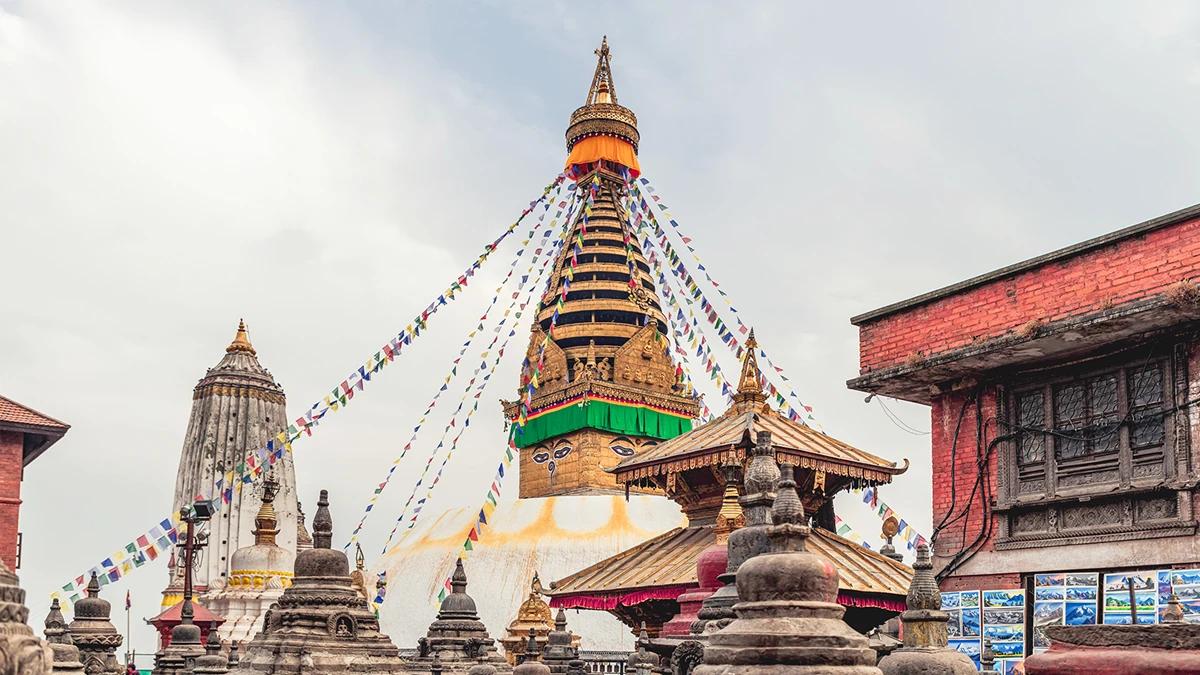
The Swayambhunath temple is an ancient Buddhist stupa on a hill overlooking Kathmandu, Nepal. It is infamous for its iconic Buddha eyes, gilded spire, and resident monkeys. Both Hindus and Buddhists visit this sacred pilgrimage site. In 1979, this site was listed as a UNESCO World Heritage Site. Read this blog to know more about the Swayambhunath Temple.
Swayambhunath Temple: The Spiritual Heart of Kathmandu

Mythological origin of Swyambhunath Temple
The Swayambhunath Temple is a historical temple with history spanning over two millennia and is linked with the legend’s stories.
According to the Swyambhu Purana, the Kathmandu Valley was once a lake. In the center of the lake, a miraculous lotus flower grew. It is believed that the lotus flower was planted by the past Buddha. The lotus flower emitted a brilliant, self-existent light (jyotirupa). Later it came to be known as Swyambhu, meaning self-created or self-existent.
Centuries later, the bodhisattva of wisdom (Manjushri) had a vision of this radiant lotus. At that time the site was not accessible. So, he cut the gorge at Chovar, drained the lake, and created the valley where Kathmandu now lies.
The lotus then was transformed into the hill on which the stupa stands now. The light was enshrined within the structure built atop it.
Historical development of the stupa
In the 3rd century BCE, Emperor Ashoka of India visited the site and constructed the temple on the hill. The temple was later destroyed in unknown circumstances. Later in the 5th century BCE, the king Vrsadeva founded the stupa. It was confirmed by the Nepalese chronicle Gopalarajavamsavali.
He damaged inscriptions at the site, further indicating that the king, Manadeva, ordered further work in 640 CE.
In the 14th century, the complex was damaged by an invading Muslim army. The complex was later repaired. From the 15th to 17th centuries, there were numerous additions and renovations. During that time, a new spire was built, and the construction of the eastern stairway was done.
In 2010, the stupa underwent major renovations. It included regilding the dome with 20 kg of gold. During the 2015 earthquake, the complex sustained damage. Later, it was largely restored.
Spiritual and Cultural Significance
The Swayambhunath Temple is a revered place. Devotees visit the stupa to perform kora (ritual circumambulation) around the stupa in a clockwise direction, spinning prayer wheels and chanting mantras to accumulate merit and find inner peace.
The spiritual seekers believe that the 365 steps leading up the eastern side symbolize the daily efforts required on the paths to enlightenment.
Besides this, the stupa represents Nepal's diverse cultural heritage and remarkable religious harmony. It is a unique place where Buddhist and Hindu practices seamlessly intertwine. Hindu shrines, including the temple dedicated to the Harati Devi, exist within the complex.
The monkeys in the temple are believed to have originated from the head lice of the bodhisattva Manjushri.
Additionally, every year, several festivals are celebrated in the stupa premises. Thousands of the devotees gather to offer prayers, light butter lamps, and celebrate with traditional music and dance, reinforcing community bonds.
Architectural Highlights of Swyambhunath
The architecture of the Swayambhunath complex is centered around its iconic stupa. It is the central and most important structure of the complex. It has a large dome-like shape.
Above the dome-like shape, there sits a cube structure that has all the eyes of the Buddha painted on four sides. Below the eye, there is a nose like a squiggle. There is also a third eye above the main eyes.
Above the cube, you can see the gilded spire featuring 13 gold-plated rings or tiers. On the very top, there is a pinnacle (Gajur) with a crescent moon and sun. At the base of the stupa, you can see the prayer wheels ringing the stupa. The mantra "om mani padme hum" is written on the prayer wheels.
Around the base of the stupa, there are five Dhyani Buddha statues set in the ornate chapels or plinths. At the top of the eastern staircase, there is the large gold-plated vajra.
How to reach the Swayambhunath Temple?
Swyambhunath Temple is easy to reach; you can get there by taxi, bus, or on foot. To reach the temple, you will also need to climb over the 300 steps.
The taxi or ride sharing is the most convenient option. You can expect to pay around NPR 600 to 1000 from central Kathmandu to the Thamel marketplace. However, it is better to negotiate before accepting the offered fare.
The taxi ride takes around 15 minutes to reach the temple entrance depending upon the traffic conditions. For booking, you can look out for the taxis and/or book the local ridesharing bikes via the local ridesharing apps like inDrive or Pathao.
The other options to reach it include the bus. It is the most affordable option; from the major stops like Ratnaapark or Lainchaur, you can catch the local bus or microbus heading towards the Swayambhunath temple.
It takes around 15-30 minutes to reach the temple depending on the traffic, plus the waiting time too. The fares are very cheap, typically under NPR 50.
Or if you are seeking a more adventurous and scenic journey, you can walk from Thamel. It takes around 30-45 minutes from Thamel to reach the Swayambhunath stupa.
Accessibility
The temple is located on the top of the hill. So, there will be accessibility challenges. There are two entrances: the eastern entrance and the western entrance.
The eastern entrance is for the walkers who want to take the stairs. The stairs are around 365 steep stone steps. This entrance is not suitable for visitors with mobility issues or health conditions.
From the western entrance, there is a motor road that goes almost to the top of the hill on the western side. So, taxis and private vehicles can drive up those roads. You will only have to walk a short distance. For the elderly visitors and those with physical disabilities, this route is recommended.
If you are riding in a private vehicle, there is paid street parking available near the western entrance.
Entry tips, suggested time to visit, and opening hours
While entering the Swayambhunath Temple, you need to cover the shoulders and knees. It is the basic dress code. Then, you need to remove the shoes before entering the main shrines.
Always be cautious of the monkeys. They are bold and may snatch food or shiny items. In the case of the circumambulation, walk clockwise around the stupa.
While it is best to visit, the temple is always open. But, for a peaceful visit, try the sunrise from 6 to 8 am. There are great lights with fewer people. In the late afternoon, you can capture the stunning sunset view over Kathmandu. So, it is also the perfect time.
Festivals and Events at Swyambhunath
There are several festivals like Buddha Jayanti, Losar, and Gunla festival celebrations happening in the Swayambhunath during the course of time. During the festivals, the temple transforms into a vibrant, bustling hub of intense spiritual energy, color, music, and community gatherings.
- Buddha Jayanti
Buddha Jayanti is one of the festivals being celebrated at Swayambhunath. It falls on the full moon day of the Nepali month of Baisakh. On this day, the stupa is heavily decorated with the prayer flags. Devotees gather in large numbers to offer prayers, flowers, incense, and candles. On this day, the entry is often free.
- Losar (Tibetan New Year)
Losar is the popular song of the Sherpa, Gurung, Magar, and Tamang communities. It is celebrated in February or March. A large number of the pilgrims visit the Sywambhunath stupa during this time.
- Gunla Festival (music and devotion during the rainy season),
Gunla festival is a month-long Newar Buddhist festival observed yearly from July to September. The Newars make daily morning pilgrimages to the stupa. They play the traditional musical instruments (Gunla Baja) and perform the circumambulations to accumulate religious merit.
The other festivals where there are participations of the devotees are Dashain, Tihar, Holi, Shivaratri, Gai Jatra, Indra Jatra, Swayambhu Festival, Shree Panchami, and so on.
What to See Around the Temple ?
Within the temple premises, you can see the several shrines and statues. The other attractions include a large Buddha park and a national museum. Below are some key elements.
- Harati Devi Temple
Harati Temple is a two-tiered pagoda-style shrine located on the northwestern side of the main stupa platform within the stupa complex. It is dedicated to the goddess Harati, protector of the children. It is believed that the goddess safeguards the children from diseases like smallpox and other epidemics.
The temple is a place where devotees perform the rituals and make offerings like kalah puja and chahayek puja.
- Viewpoint for Kathmandu Valley (sunrise/sunset)
There are several viewpoints around and in Swayambhunath Temple, including Swayambhu Backside View Deck, White Monastery Road Point, Halchowk Hill, Swayambhu Upper Viewpoint (Shantipura side), Swayambhu Western Stupa Hill Ridge, and Manjushree Park Hill Trail (Thamel side).
From these viewpoints, you can see the full 360-degree view of the Kathmandu Valley and other scenery.
- Small monasteries and prayer flags
There are several monasteries in the Swayambhunath stupa premises and around it. Some of the popular monasteries include Sangye Choeling Monastery, Triten Norbutse Monastery, Shantipur Shrine, Kimdol Bihar (Kimdol Monastery), and so on. You can also see the vibrant prayer flags around and on the site itself.
Traveler Tips and Etiquette to Follow While Visiting Swyambhunath Temple
- Wear loose-covering clothes for both men and women (shoulders and knees)
- Take off shoes and hats before entering stupas or monasteries.
- Maintain a calm, low voice while on the premises.
- Turn off your phones and remove headphones.
- Use your right hand to give or receive things like prasad or money.
- Don’t touch the Buddha statues or monks or nuns.
- Be aware of monkeys. Don’t tease them, and protect your bag or phones from them.
- Be mindful of pickpockets, especially in the crowded stairways where all are distracted.
- Visit the stupas early in the morning around 6-8 am or late afternoon at 4-6 pm for fewer crowds and beautiful views of the Kathmandu valleys.
- Hire a local guide to learn about the historical stories of the stupa.
- Wear comfortable walking shoes. It is good during navigating the steps and uneven terrains.
FAQs
1. Why is Swayambhunath called the Monkey Temple?
Swyambhunath is called the monkey temple because in the temple, hundreds of the sacred monkeys inhabit the temple grounds. It is believed that these monkeys are the descendants of the lice from the bodhisattva Manjushri’s hair and are considered guardians of the site by the visitors.
2. What is the best time to visit Swayambhunath?
The best time to visit the Swayambhunath Temple is early in the morning or late in the afternoon/evening in the cool seasons like spring and autumn. Avoid the Saturdays, as locals come to visit the stupa during their local weekend. And avoid the monsoon season, as the heavy rainfall may disrupt the visits.
3. Is there an entrance fee at Swayambhunath Temple?
Yes, there is an entrance fee for the Swayambhunath stupa. The rates are different. The entrance fee for foreigners is around NPR 200, for SAARC nationals it is around NPR 50, and it is free for the Nepali citizens and children under 10.
4. How many steps are there to reach the temple?
To reach the Swayambhunath Temple, you will need to walk around 365 steps.
5. How long does it take to explore Swayambhunath?
To fully explore the main Swayambhunath Stupa complex, you will need approximately 1-2 hours. However, if you want to explore the surrounding park, museum, and nearby temples, it will take around 3-5 hours.
InformationLiving TraditionsMyth and TraditionsNepalNepali cultureNepali HistoryNepali Tradition And CulturePhotographySacred TraditionsTradition MattersTravelTravel And CultureTravel factsTravel For TraditionTravel guide and tipsTravelerWanderlust
Need Help? Call Us on WhatsApp+977 9851323302orChat with us
Latest Travel Blogs
Nov 14, 2026By VIPUL
Trekking Grades in Nepal
Nov 14, 2026By VIPUL
8 Most Popular spring treks in Nepal for 2026
Nov 13, 2026By VIPUL
What to Expect From a Yoga Retreat in Nepal in 2026?
Need Help? Call Us.+977 9851323302