Ancient History of Nepal
The evidence traces the human settlement back nearly 30,000 years, with Neolithic tools found in the valley dating to 9,000 BCE. The exact locations were Luvu (Lalitpur) and the Budhanilkantha/Dhobi Khola area. The tools found were polished stone tools, including axe fragments.
According to Buddhist legend, the Kathmandu Valley was once a vast lake known as Nagadaha. Then, the Bodhisattva Manjushri cut a gorge at Chobhar with his sword, drained the water, and made the valley habitable.
The above evidence and story suggest that the ancient history of Nepal is primarily focused on the Kathmandu Valley. Traditionally, the Kathmandu Valley was known as Nepal (according to the early dynastic records). Like this, you can find multiple theories and evidence.
Earlier, the Gopala dynasty (cowherds) used to rule in the Kathmandu Valley. Legends say that they were the first rulers of the valley. The Gopalas arrived from the south during the end of the Dvapara yuga. Their first king was Bhuktaman.
The Gopala dynasty was replaced by the Mahisapala dynasty (buffalo herders). The Mahispala were also called the Abhiras. They ruled for several generations before being overthrown by the Kirat dynasty (c. 800 BCE-300 CE).
Some people also argue that the first king was Yalambar. And it is kind of true too. Because the Kiratas were the first documented tribe. However, most of their early history remains unknown.
During their regime in the Kathmandu Valley, in c. 563 BC, the founder of Buddhism, Gautama Buddha, was born in Lumbini, Nepal. He was the prince of the Shakya clan, initially named Siddhartha Gautam. His teachings laid the foundation for Buddhism.
In the same era, in c. 250 BCE, the Mauryan Emperor Ashoka visited Lumbini and erected the Ashoka Pillar. It is also considered the earliest verified historical inscriptions in the region.
There was the rule of the Lichhavi dynasty (c. 300 CE-879 CE) after the Kirat era. It was called the golden age. They introduced advanced administrative systems, trade, and art. The historical inscriptions at Changunarayan were from King Manadeva I. The Amshuverma opened trade routes to Tibet.
Thereafter, following the decline of the Lichhavis, the Thakuri dynasty ruled. Their regime was called a dark period in the history books, as many historical records are not available of those periods.
By the 12th century, the Malla dynasty ruled. This part of the history marks the transition into the mediaeval period. During this period, Newari art flourished. There also was eventual division of the valley into three kingdoms.
Kingdom of Nepal and Transition
The Kathmandu Valley was developing as a part of a separate kingdom. At the same time, there were several independent hill states.
These distributed Malla-ruled states were united in 1768 AD by the ruler of the Gorkha Kingdom, Prithvi Narayan Shah. He moved the capital to the Kathmandu Valley and established the modern Shah dynasty. He expanded the country.
Thereafter, the Shah dynasty ruled the sovereign Hindu Kingdom of Nepal for 240 years. There were so many ups and downs during this era.
During the conflict with the British East India Company in 1814–1816, Nepal lost an important part of its territory. This treaty was called the Sugauli Treaty.
In 1846, the Kot massacre happened in Nepal, leading to the Rana family in power. The prime ministers from the Rana family exercised absolute control. The Shah rulers were reduced to figureheads (1846-1951) for 104 years.
Later in 1951, the popular people’s rebellion ended Rana rule and restored the monarchy with King Tribhuvan in power. In 1955, King Tribhuvan died, and his son King Mahendra came into power. He held Nepal's first democratic general elections under a new constitution in 1959.
Later in 1960, King Mahendra brought the partyless political system by coup that granted the monarch absolute authority. He dissolved the parliament and banned all political parties. After his death, King Birendra took the responsibility of the throne.
Again in 1990, the people's movement transformed the nation into a multi-party democracy under a constitutional monarchy. At that time, King Birendra Shah was on the throne. He was forced to lift a ban on the parties.
But the system still struggles. During 1996-2006, a civil war was going on. In the same era, in 2001, the royal massacre (King Birendra’s family killing) happened. King Gyanendra dismissed the government and assumed the power to fight the rebels in 2005.
During this event, the 19-day popular uprising forced the king, Gyanendra, to reinstate parliament and relinquish power. These events triggered the 240-year-old monarchy coming to an end. The peace deal was signed on May 28, 2008, with rebels.
Since then, Nepal has been a federal democratic republic where the president is the ceremonial head of state and the prime minister is the executive head.
Nepal's Ethnic Diversity
The Nepali population is broadly classified into numerous major groups. These groups are based on linguistic and ancestral origins.
The largest cluster is the Khas Arya group, also known as the hill group. This group is about 39.37% of the total population. This cluster includes Chhetri (16.6%) and Hill Brahmin/Bahun (12.18%). The Chhetris and Brahmins are known for their influence in politics and administration.
Then comes the Adivasi Janajati (Indigenous Nationalities). They make up 30.81% of the population. The Adivasis who reside in hills or mountains include the groups like Magar (6.9%), Tamang (5.6%), Rai, Gurung, and Sherpa. The Adivasis who reside in the Terai include the Tharu (6.2%).
The Madhesi groups constitute roughly 23.43% of the total population. This group includes Yadav (4.21%) and various other caste groups. Talking about the other inhabitants, there are about 5.5% Newars living in the country.
Dalits make up about 14% of the population. This group includes castes like Kami, Damai, and Sarki.
Religious diversity of Nepal
Before, Nepal was a Hindu kingdom. In 2008, the country transitioned into a secular state.
In Nepal, the majority of the population still follows the Hindu religion, with 81.19% of the population. Their predominant faith is central to national identity and legal holidays. The Hindus celebrate the festivals like Dashain, Tihar, Maha Shivaratri, Holi, Teej,
Buddhism follows Hinduism at 8.21% of the population. They are deeply rooted, with Lumbini being the birthplace of Lord Buddha.
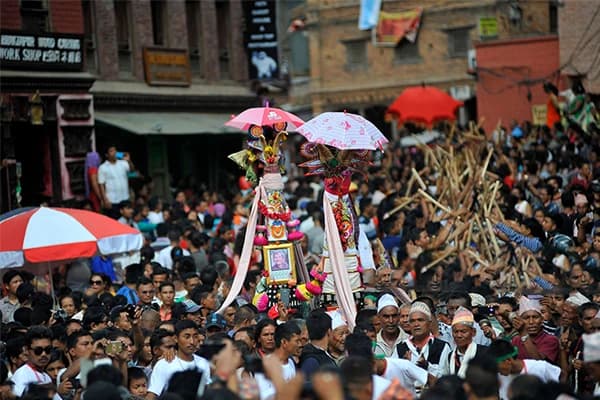
Buddhism often blends with Hinduism through elements like beliefs, cultures, or schools of thought. They celebrate festivals like Buddha Jayanti; Indra Jatra (especially by Newars); Losar (by Sherpa, Tamang, and Gurung communities); Chhath (by Terai region peoples); and Mani Rimdu (Sherpa community).
The other religions include Islam (5.09%: concentrated in the southern Terai region); Kirat (3.17%: practised by Rai and Limbu groups in eastern Nepal); Christianity (1.76%); and others (<1.0%: including Prakriti {nature worship}, Bon, Jainism, Sikhism, and Baha'i).
Language and Literature
The historical events, ethnicity, and religious diversity have shaped Nepalese culture.
According to the 2021 census, over 124 languages are spoken in Nepal, with the official language being the Nepali language. The Nepali language is spoken by 44.86% of the population as a mother tongue and by roughly 78% as a first or second language.
Other major regional languages are Maithili (11.05%: second most spoken language), Bhojpuri (6.24%: widely spoken in Chitwan and Parsa), Tharu (5.88%: mainly spoken in the Terai region), Tamang (4.88%), & Nepal Bhasa/Newari (2.96%).
Talking about Nepali literature, it has evolved from the ancient religious scriptures to a vibrant contemporary scene. The classical icons who shaped the literary heritage through their work include Bhanubhakta Acharya (Adi Kavi) and Laxmi Prasad Devkota (Mahakavi).
In the 20th century, writers like B.P. Koirala and Parijat (known for Shirishko Phool) shifted the literature towards social realism and psychological depth.
Art and Architecture
Nepal is a hub of art and architecture. The traditional arts like Paubha (original Newar religious painting style), Newar woodcarving, and statuary (a millennium-old tradition).
The example of Newar woodcarving is seen in the "55-window palace" and the "Peacock Window" in Bhaktapur. The other examples are seen in the major monuments.
In Nepal, you can see the three traditional styles of the architecture landscape, like pagoda style, shikhara style, and stupa architecture.
The pagoda style is characterised by multi-tiered roofs and intricate wood carvings. The most popular example is the Nyatapola temple. The constructions like Kasthamandap and Rani Pokhari were newly rebuilt, but the techniques used were traditional.
The shikhara style is a tall, pyramidal, or curvilinear stone structure. These structures represented the crown of the Himalayas. This style was primarily inspired by Indian Gupta architecture. One of the best examples of the shikhara style is Krishna Mandir in Patan.
Last but not least, the stupa style is a hemispherical dome topped with a square base (the "eyes of Buddha") and a spire. The best examples are Swayambhunath and Boudhanath.
Ancient Music and Dance
There are over 200 original music instruments, with about 108 still in active use. Each instrument is connected with great musical history. The popular instruments are panche baja, nadal, sarangi, damphu & tungna. These instruments define the sonic landscape of Nepal.
Some of the popular dances include Charya Nritya, Kartik Naach, Lakhey Dance, Ghatu Naach, and so on. These art forms have been passed down through the oral traditions and community systems for over two millennia.
Nepali Handicrafts
Nepali handicrafts are the best fusion of the spiritual symbolism and ancient craftsmanship. The major categories of the Nepali handicrafts include sacred Thangka paintings, luxurious Pashmina textiles, and intricate metal and wood carvings.
These handicrafts are primarily produced by the Newar, Shakya, and Tamrakar communities. Below are some of the best examples of the Nepali handicraft industries.
- Thangka paintings are basically sacred scroll paintings on cotton or silk using natural mineral pigments and often 24K gold.
- Singing bowls are hand-hammered bowls made from an alloy of seven metals. It is used for sound healing.
- Metal statues are created using the ancient lost-wax casting method in Patan. It often depicts Buddha, Tara, and various Hindu deities.
- Pashmina and cashmere are handwoven from the fine undercoat of Himalayan Chyangra goats.
- Felt products are items made by matting wool using steam and pressure.
- Dhaka textiles are unique, hand-loomed cotton fabrics with intricate geometric patterns. These are used for traditional hats and shawls.
- Wood carvings are intricate carvings seen in the windows and doors of the Kathmandu Valley. It often features the protective deities or floral motifs.
- Khukuri (Gurkha Knife) is a functional yet artistic representation of the legendary Gurkha blade.
Nepali Cuisine and Traditional Clothing
Nepali cuisine is mainly defined by its regional diversity and the iconic status of Dal Bhat. Whether it is grain-heavy diets of the Himalayas or the spicy, varied produce of the Terai plains, Nepali meals are the best ones.
Some of the best examples of Nepalese cuisine include Dal Bhat Tarkari, Dhido, Momo, Yomari (sweet steamed rice-flour dumplings), Chatamari (rice crepes often called "Nepali pizza"), Bara (savoury lentil patties), Gundruk, Sel Roti, and many more.
While traditional clothes vary across more than 100 ethnic groups, with Daura suruwal and Gunyo cholo. It is the marker of ethnic identity. However, nowadays, the national customs are used for official and formal occasions.
The best traditional Nepal attire examples are Daura Suruwal (men), Gunyo Cholo (women), Haku Patasi (Newar), Bakkhu (Sherpa/Tamang), Dhoti and Lungi, and Sari and Kurta Suruwal.